

Just at the time when ChatGPT 6 Astra was arriving, we finished two papers and we also released them. I wrote about this on X, it was a short announcement. Now I want to write about what is in the papers, and what was my experience with working on this. Short summary: this was the first time, when I felt that there is beauty and creativity in the output of the AI. And I was constantly amazed. Among many smaller or bigger results, I had one conjecture, and neither me, nor earlier OpenAI models could do anything with it. Really, there was no progress. And now 5.6 Sol one-shotted it, the proof was two pages long (!!!), I did not believe what I saw… and when I understood it, I felt that this is a proof from The Book.
These are the two a papers:
https://zenodo.org/records/22305637
https://zenodo.org/records/22306151
(the first will be on the arxiv tomorrow, the second one will be rewritten before uploading to arxiv)
The scientific problem
I will now describe the topic, but then I also want to document the discovery process. Therefore, the scientific content will be more detailed than usually in this blog.
So this is a topic in quantum many body physics. The questions are physics motivated, but in the end the research project is very mathematical. Just like in most of my work.
The overarching big questions are: how complex is time evolution in quantum mechanics? Which are those systems that are tractable, where the complexity is mild, and we can follow the dynamics with formulas on a piece of paper or with numbers in a classical computer?
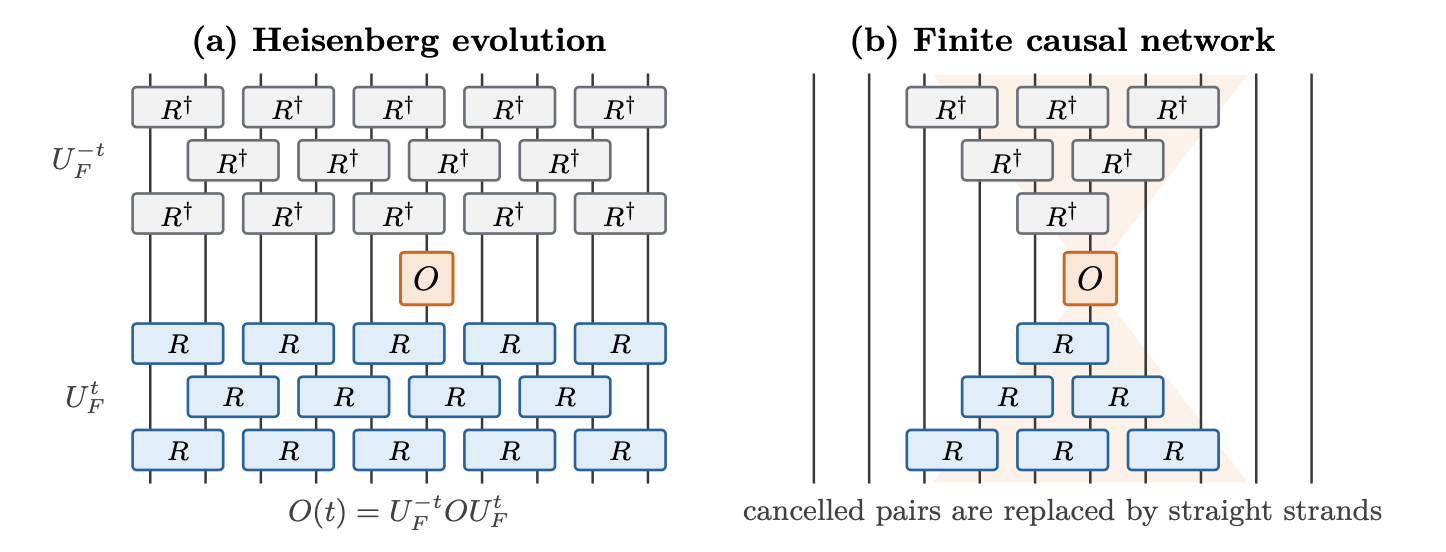
More specifically we look at the so-called quantum integrable models, more specifically integrable spin chains. We consider the Heisenberg time evolution of a local observable, and consider its spreading over the system. We focus on the bi-partite entanglement of the initially local operator. This quantity is a measure of the quantumness and/or complexity of the time evolution. It does not tell us all about the dynamics, but it can be a probe. For the specific systems we choose “brickwork quantum circuits”, special 1D quantum cellular automata, they generate discrete time evolution, they can be realized on an actual quantum computer, and very often they are more tractable analytically then the continuous time systems.
See pic from the paper for a schematics of Heisenberg time evolution in a brickwork circuit. Explanations given in the first paper.
It was observed in many examples, that in “normal” chaotic circuits the operator entanglement grows linearly with time, whereas in integrable models it grows at most logarithmically. The first one is a relatively standard statement, the second one is extraordinary. Integrable models are special, because they have many “higher” conserved quantities, therefore, their dynamical processes are constrained. These constraints do not prevent a linear entropy growth for states (in the Schrödinger picture), but it appeared that for local operators the growth is only logarithmic (in Heisenberg picture).
This logarithmic growth was never proven, and all that the researchers had was a collection of examples. Nevertheless, the message was compelling. It was never formalized into a Conjecture, but it was an “expectation”, stated in various works. See for example the abstract of this paper:
“For chaotic systems the local-operator entanglement is expected to grow linearly in time, while it is expected to grow at most logarithmically in the integrable case. “
The expectation goes back to this paper from 2007 (or perhaps even earlier?), so we can say that it is at least 19 years old.
The discovery process
I always wanted to understand this phenomenon, and I wanted to prove the expectation. However, it was so general, that I had no idea how to approach it. All I could think of was looking at examples, just like the others did before.
When I started to use AI and I understood that it is indeed capable, I came up with some specific research questions in this topic. I wanted to know, what happens in brickwork circuits when we choose the gate to be a solution to the braid relation. This means that the model is integrable, however, the setting is still quite abstract, and we can ask general questions. If we only know that the braid relation holds, is this enough to guarantee the logarithmic growth?
Interestingly, earlier models of OpenAI could not answer the question. What is more, ChatGPT 5.2 came up with a completely mistaken proof. It looked OK at first, but then I saw that one point was smeared. I went to look at that point, asked for clarifications, and it turned out, there was nothing behind the smearing. The main part of the computation was simply just missing. I also did some numerical studies, which confirmed that the proof is just mistaken.
At that point I thought that this topic will remain difficult for a long time. I asked the same question from the models that appeared, 5.4 and 5.5., and they did not have anything to add.
And then 5.6 one-shotted a specific question that I asked. And it could also solve some other questions with some guidance. This was where I was in complete awe.
I followed the computations, I understood them, and I just wanted to proceed. It was me who came up with specific criteria for the log growth, and the AI had to prove that the criteria are indeed sufficient. And in a few cases this actually worked. And I became more and more bold, and I wanted to crack the whole problem. To prove or disprove the main conjecture.
For the first paper the AI came up with an integrable example where the operator Schmidt rank was growing exponentially. However, it could not compute the operator entanglement. I asked it to do some numerics, and to consider the analytical computations in light of the manuscript. The AI told me that the entanglement likely grows with a square root of time (instead of the standard log)… This seemed unbelievable to me!
Then I started a new Session, Sol Ultra in codex, I collected all previous experience, together with the recent numerical data, and I asked the AI to focus on all of this together, and finally try to come up with an example, that would show faster than logarithmic growth. An example, where we could actually compute it, prove it.
And I did not believe what I saw: in a relatively short time (less than 2 hours) the AI found an example where the proof is possible, the growth law is a square root of time. Thereby disproving the 19 year old conjecture/expectation.
At this point I asked István Vona to join the project, we started to check the computations, István started to perform numerical checks, he also derived further refinements of the first formula for the entanglement growth. And eventually we also performed autoformalization of the most crucial statement: the lower bound with a sqrt law growth. All of this is going now into the second paper.
Creativity
The constructions that the AI found are remarkable. They consists of simple ingredients… however, for the first time I felt that maybe this would not have been found without AI. In part because some of the interesting examples in the two papers (including the actual counter-example) are somewhat exotic, they assume a spin chain with local dimension 6 or 7. I don’t think humans would have looked at such cases, because in many-body physics normally people consider qubits, qutrits, ququarts at most.
As an example, the figure below shows the process of entanglement creation in a system with D=7. This is in the first paper, Section 11, and the process shows that the Schmidt rank of local operators can grow exponentially even with Yang-Baxter gates. The crucial point was that the Bell pairs can be created in a controlled way, even with the gates that satisfy the braid relation.
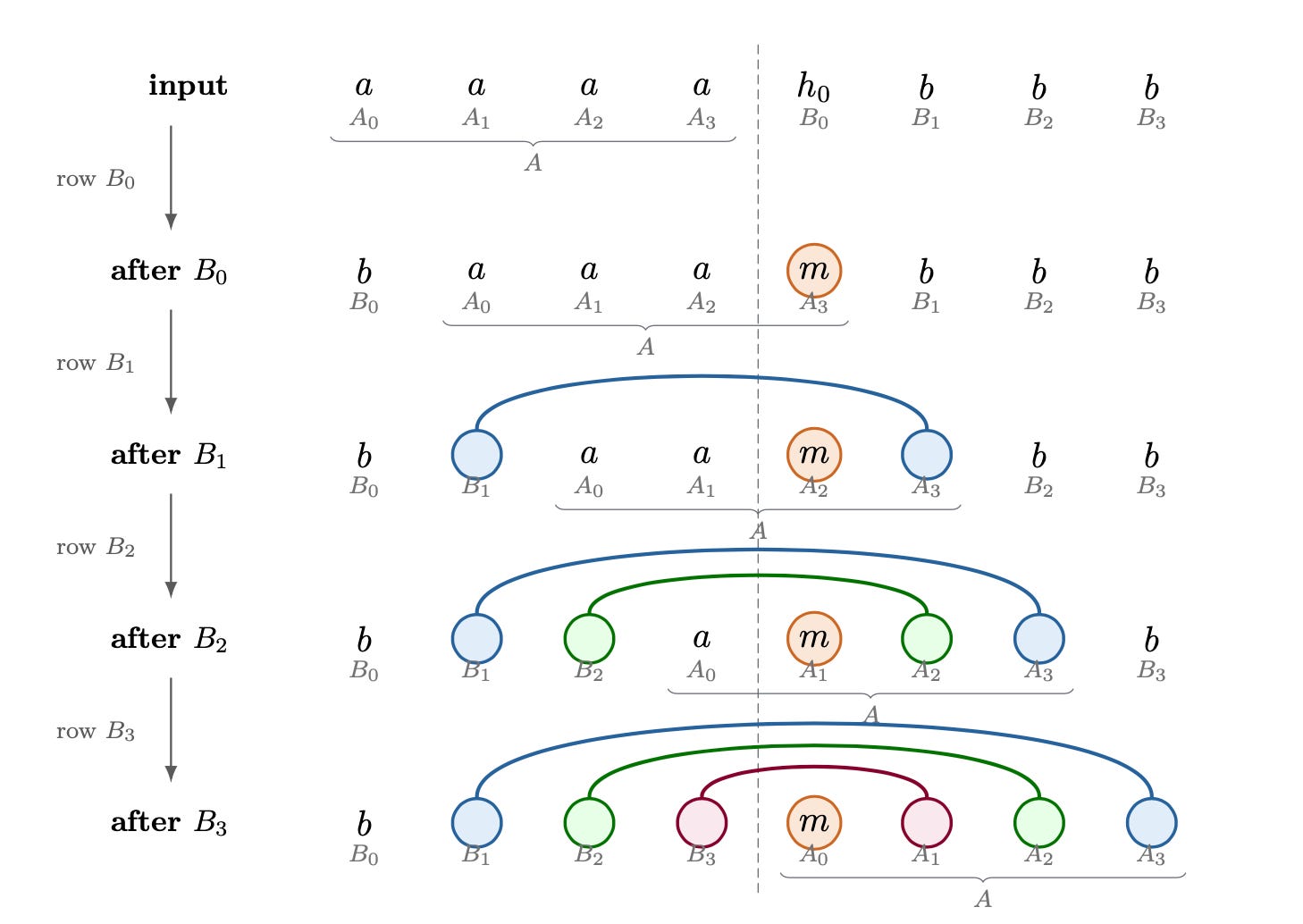
This was not an out of this world move… but a very nice construction nevertheless. A very good PhD student could have found it and construct it, within a few months. And it would have made the student very proud!
So I would not yet call these examples a Move 37… but they are coming close. There is clearly a vivid creativity behind the steps, the constructions, the proofs. I understand that the AI is just a machine, which combines many many existing ideas scattered in the literature. But I can’t help feeling that the output shows creativity.
Beauty
I also feel that some of the proofs have an inner beauty. Not all of them. Actually, I don’t think that the construction of the counterexample is particularly beautiful. I think it is clever, tricky…. but not beautiful. However, when I consider the proofs in the first paper, those that give sufficient criteria for the log growth, then I get a sense of beauty.
There is one example which I really like. The AI proved that if the dynamics generating two-site gate satisfies the braid relation, is involutive, and is also dual-unitary, then the entanglement growth is logarithmic in time. Assembling these criteria was my idea, but I could not proceed with the computations myself. I always hoped that one could come up with a nice proof, using diagrams, braid moves, but I could not do it. And the AI showed me what was missing, and it did it in a beautiful way.
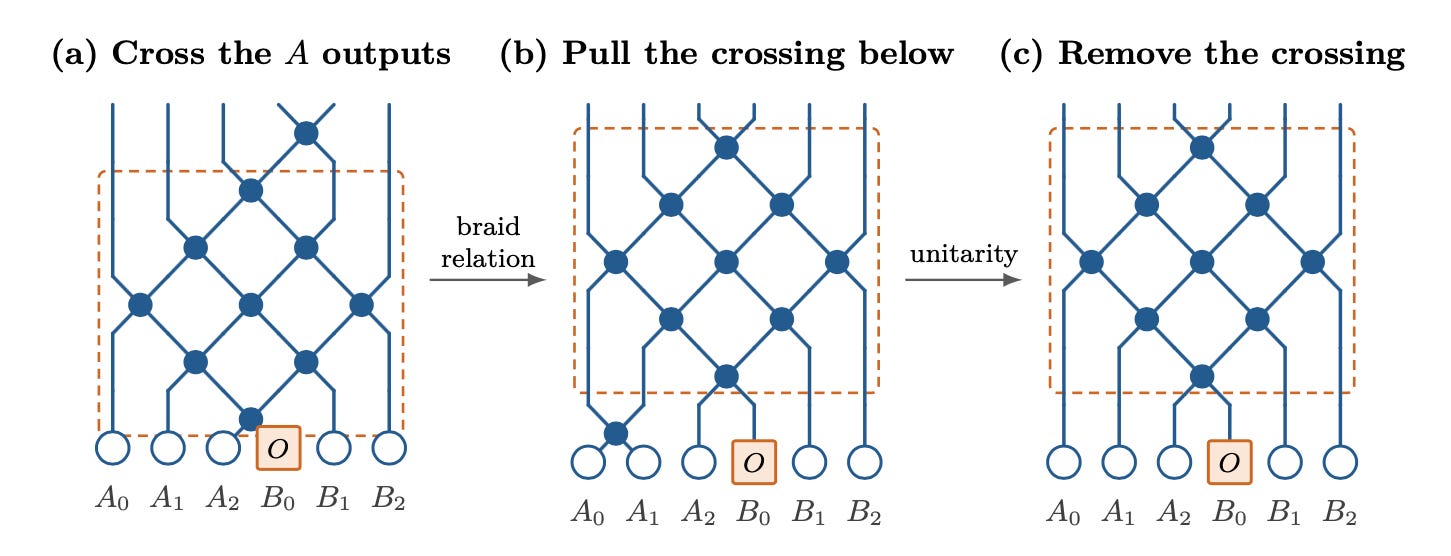
The solution was to apply braid moves for an intermediate object, not the actual time evolved operator (or its tensor network representation). This way, the AI could establish a certain invariance property: the output is invariant with respect to a selected set of further braiding operations. This observation could be used to bound the dimensionality of the output, by making connection to the representation theoretic work of Lechner, Penning and Wood. The figure above is from the paper, I can’t add explanations here. I am just saying: this is the nicest part of the proof.
So what was beautiful here? Simply just coming back to the braid moves, and finding the precise setting where they can be applied, and where they are actually directly useful. This is what I always wanted to find. Perhaps other scientists could have found this, again, it does not yet feel out of this world. But it feels like a proof from the Book.
An outlook on button pushing
There is an active discussion about the future of mathematics (and science in more general) all over the place. On X, in forums, in blogs, etc. I don’t think I can add anything useful here, but I would like to share my experiences with this project.
In summary: I had lots of fun, I learned a lot, the work was very exciting. I felt like being a strange combination of a PI and a student. I determined the research direction, I gave guidance, but then I also had to learn. I had to learn a lot, and I did.
Altogether I felt I have agency. I was selecting the problem, and various directions. In some cases I also gave concrete ideas. I synthetized the pieces the AI gave me. I figured out the way to make the AI create the counterexample.
Right now we are living in an extraordinary time: the AI can be as good as a human in many tasks, and in some tasks even better. But altogether we can work as partners, as collaborators. It feels good to experience this.
And I know that this might not last very long. I don’t know yet what Astra can do. What will the models of 2027 do? Will they be more clever also in asking the next research questions?
I think this is the next serious frontier. Theory building, and choosing new interesting directions. So far AI has not excelled in this. If it will, then that might be a completely new situation indeed.
Right now I have a very pragmatic attitude: I am enjoying the current moment we live in, and I am just trying to make the best out of it.
The Fields medal winner Hugo Duminil-Copin said that he will not use AI in his creative processes. This might be a good personal decision.
At the same time, I think that it would be a pity not to use this technology, just at the time when humans and machines can work as almost-equal partners, side by side.
This extraordinary moment might not last very long.